
"I'm eating healthy. Why am I still gaining weight?"
Or maybe your periods have become unpredictable.
You're constantly bloated.
Feeling tired.
Breaking out more than usual.
And wondering why your body suddenly feels different.
If this sounds familiar, you're not alone.
At Prakriti Yog, many women walk into our studio with exactly these concerns.
Most are working professionals from Noida and Greater Noida West, balancing demanding jobs, long commutes, late dinners, and very little time for themselves.
Many assume it's just stress.
Others ignore it until their periods become irregular.
Sometimes, these changes can be linked to PCOD or PCOS.
The good news? With the right medical guidance, consistent lifestyle changes, and yoga, many women begin feeling much more in control of their health.
What is PCOD/PCOS?
PCOD (Polycystic Ovarian Disease) and PCOS (Polycystic Ovary Syndrome) are hormonal conditions that affect many women during their reproductive years.
Simply put, your body starts producing hormones in an imbalanced way.
These hormones help regulate your menstrual cycle, metabolism, skin, mood, and ovulation.
When they're out of balance, your body begins sending signals that something isn't quite right.
Think about cooking your favourite dish at home.
Even if you have all the right ingredients, adding too much salt or forgetting one important spice can change the entire taste.
Your hormones work in a very similar way.
They don't need to disappear completely to cause problems—even a small imbalance can affect how your body functions every day.
That's why PCOS isn't just about your ovaries.
It can influence your periods, weight, energy levels, skin, hair, mood, sleep, and even fertility.
Symptoms: How Do You Know If It Could Be PCOD or PCOS?
Not every woman experiences the same symptoms.
Some have only one or two.
Others may notice several together.
Common signs include:
- › Irregular or missed periods
- › Unexplained weight gain, especially around the abdomen
- › Acne that continues into adulthood
- › Excess facial or body hair
- › Hair thinning or increased hair fall
- › Feeling tired even after enough sleep
- › Difficulty losing weight
- › Mood swings & persistent bloating
- › Trouble conceiving
Having one of these symptoms doesn't automatically mean you have PCOS.
If you're experiencing multiple symptoms consistently for a few months, it's worth speaking to a gynecologist for proper evaluation.
Is Every PCOS Case Equally Serious?
No.
Some women have very mild symptoms and continue with regular cycles.
Others may experience significant hormonal imbalance, irregular ovulation, or insulin resistance.
Your doctor may recommend:
- Blood tests
- Ultrasound
- Hormonal evaluation
- Targeted lifestyle changes
The earlier it's identified, the easier it usually becomes to manage.
Cause: Why Does PCOS Happen?
There isn't one single reason.
It's usually a combination of factors, such as:
- › Genetics & insulin resistance
- › Chronic stress & poor sleep
- › Sedentary lifestyle & weight changes
- › General hormonal imbalances
For many working women in Noida, another factor quietly adds to the problem:
Long sitting hours.
Skipping breakfast.
Late-night work.
Ordering food because there's no time to cook.
Sleeping after midnight.
Your body isn't designed to stay in stress mode all the time.
Over months and years, these habits can influence your hormones more than you realise.
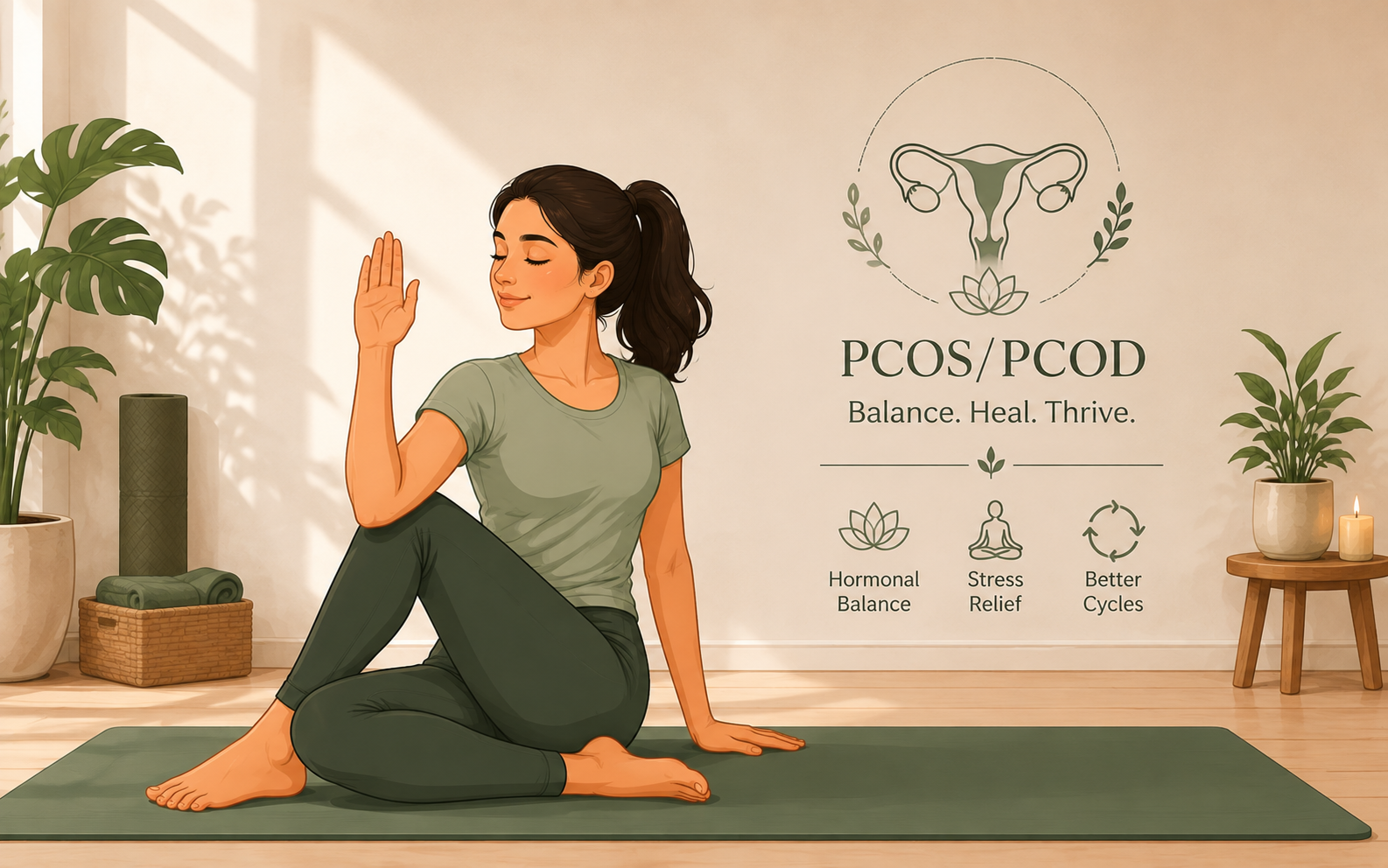 Therapeutic, gentle movements designed around female physiology and endocrine health.
Basic First Step: What Can You Do?
Small, consistent habits make a bigger difference than trying everything at once.
1. Move your body every day
You don't need exhausting workouts. If you're already stressed, extremely intense exercise every day may leave you feeling even more drained. Gentle yoga helps improve circulation, supports hormone regulation, and reduces stress without extra strain.
2. Prioritise sleep
Your hormones recover while you sleep. Aim for 7–8 hours of quality sleep and try keeping a regular bedtime, even on weekends.
3. Eat balanced meals
Instead of skipping meals or following crash diets, include protein with every meal, seasonal vegetables, whole grains, healthy fats, and plenty of water. Small, regular meals are often easier for your body than long gaps followed by heavy dinners.
4. Practice Yoga Consistently
Yoga isn't about touching your toes. It's about helping your body move better, breathe better, and respond to stress differently.
At Prakriti Yog, our Hormonal Balance Yoga sessions may include:
- Butterfly Pose (Baddha Konasana): Supports hip mobility and pelvic circulation.
- Cat-Cow Stretch (Marjaryasana–Bitilasana): Improves spinal mobility while gently stimulating the abdominal region.
- Bridge Pose (Setu Bandhasana): Strengthens the lower body and helps improve posture after long desk hours.
- Deep Breathing & Relaxation: Reduces stress levels, helping the body shift out of constant "fight or flight" mode.
Yoga works best when practiced consistently over time—not occasionally.
What Should You Avoid?
Many women unintentionally make these mistakes:
- Crash dieting: Skipping meals may temporarily reduce weight but often increases cravings and leaves you feeling exhausted.
- Exercising too aggressively: Doing high-intensity workouts every day while you're already stressed isn't always the answer. Your body also needs recovery.
- Comparing yourself to others: Every woman's hormones are different. Focus on your own progress instead of someone else's timeline.
When Should You See a Doctor?
Yoga can be a valuable part of managing PCOS, but it shouldn't replace medical care.
Please consult a gynecologist if you experience:
- › No periods for three months or more
- › Extremely painful or unusually heavy periods
- › Sudden weight gain without explanation
- › Difficulty conceiving
- › Severe acne or excessive hair growth
- › Symptoms that continue getting worse
Your doctor can diagnose the condition accurately and recommend the right treatment plan.
A Gentle Reminder
If you've recently been diagnosed with PCOD or PCOS, don't panic. Many women manage their symptoms successfully by combining medical advice with healthy daily habits.
You don't have to change everything overnight. One walk. One yoga session. One better meal. One good night's sleep. These small choices add up over time.
If you're looking for women-only yoga classes focused on hormonal balance, we'd love to welcome you to Prakriti Yog at Gaur World Smart Street, Greater Noida West. Explore our dedicated Hormonal Balance Program tailored for PCOD and endocrine health.
You're welcome to join us for a complimentary trial class, meet our instructor, and experience our small-batch sessions before deciding what's right for you. Sometimes, the first step is simply showing up for yourself.